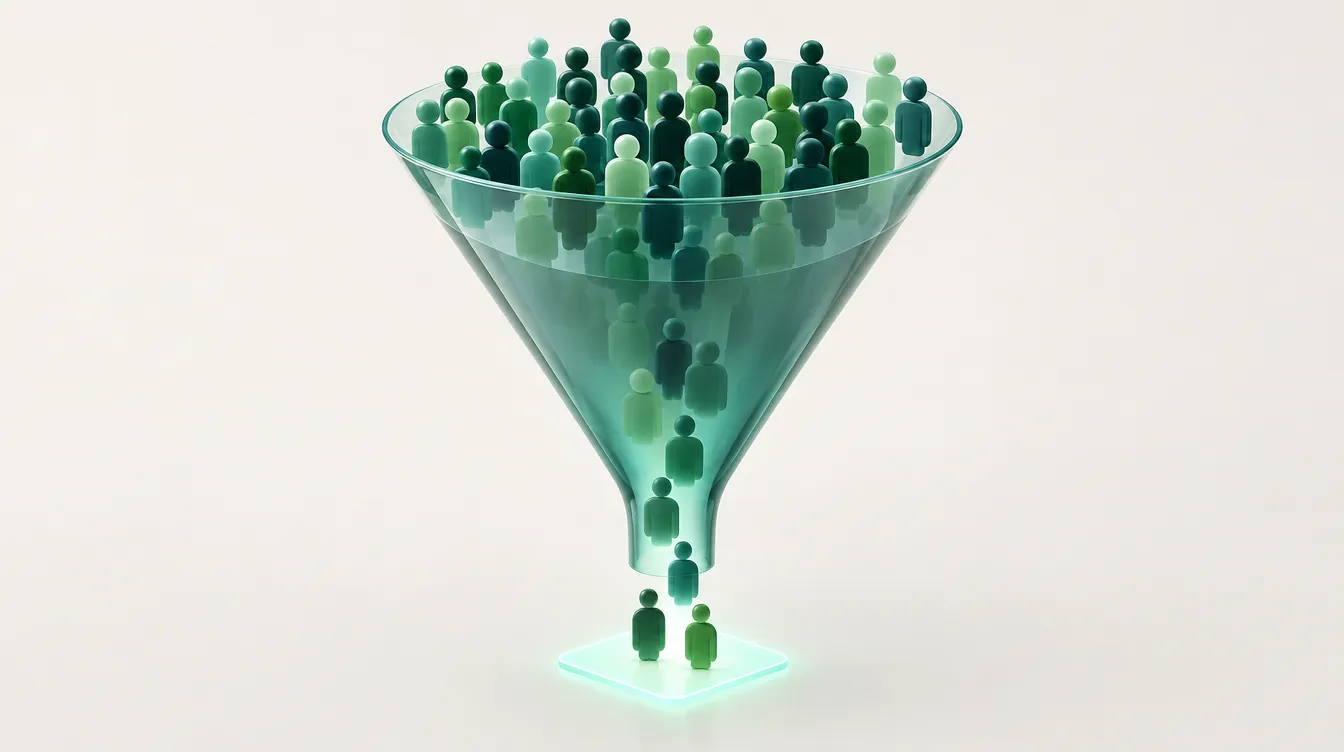
A marketing funnel (also called a sales funnel) is a model of the stages a customer goes through from first contact with your business to a purchase. Fewer people pass through each stage, which is why it is drawn as a funnel. It shows where you lose prospects and which stage deserves your time and budget.
In brief:
- The funnel usually has three stages: TOFU (awareness), MOFU (consideration) and BOFU (decision); retention follows the purchase.
- Each stage has its own goal, channels and metric.
- AIDA (Attention, Interest, Desire, Action) follows the same logic and works best for writing copy.
- You find the weak spot through the conversion rate between stages, not through overall numbers.
What a marketing funnel is and why it matters
At the top are many people who have just heard of you; at the bottom, the few who buy. Real customer paths vary, so the model is a simplification. Its value is structure: for each stage you know the next step and how to measure it.
In practice, “we need more traffic” becomes a precise diagnosis: traffic is fine, but nobody fills in the form. Then you fix the page, not the ad budget. The funnel builds on your marketing strategy: strategy defines what you offer and to whom, the funnel how a stranger becomes a customer.
Funnel stages: TOFU, MOFU, BOFU and after the purchase
| Stage | Goal | Channels | Content | Metric |
|---|---|---|---|---|
| TOFU – awareness | get noticed | SEO, social media, ads | articles, videos, guides | visits, reach |
| MOFU – consideration | earn trust and a contact | email, retargeting, website | checklists, comparisons, webinars | leads, conversion rate |
| BOFU – decision | close the sale | search ads, email, phone | offer, pricing, case examples | orders, enquiries |
| Retention | repeat purchase, referral | email, customer care | how-tos, offers for customers | repeat orders, reviews |
In the middle stage, the goal is to win a lead, a contact from someone who has shown interest. Retention is often neglected, though you have already paid to win the customer.
The AIDA model in marketing
The AIDA model describes four steps: grab attention, build interest, create desire and prompt action. It follows the same path as the funnel, only at the scale of one page, ad or email.
It is traditionally attributed to US advertising pioneer E. St. Elmo Lewis and the late 19th century, largely thanks to Edward K. Strong’s 1925 book. Recent research (A. Iwamoto, 2024) notes there is no direct evidence from 1898 and that others, such as Arthur F. Sheldon, shaped the model too.
How to use AIDA in copy
An illustrative example for a fictional accounting firm’s landing page:
- Attention: “Your tax return, sorted before the deadline” – a headline aimed at a specific problem.
- Interest: “Upload your receipts to a shared folder and we keep track of the deadlines.”
- Desire: “You know the price in advance and don’t have to think about your tax return.”
- Action: a button reading “Book an intro call”.
The most common mistake is a missing A: engaging copy that never says what to do next.
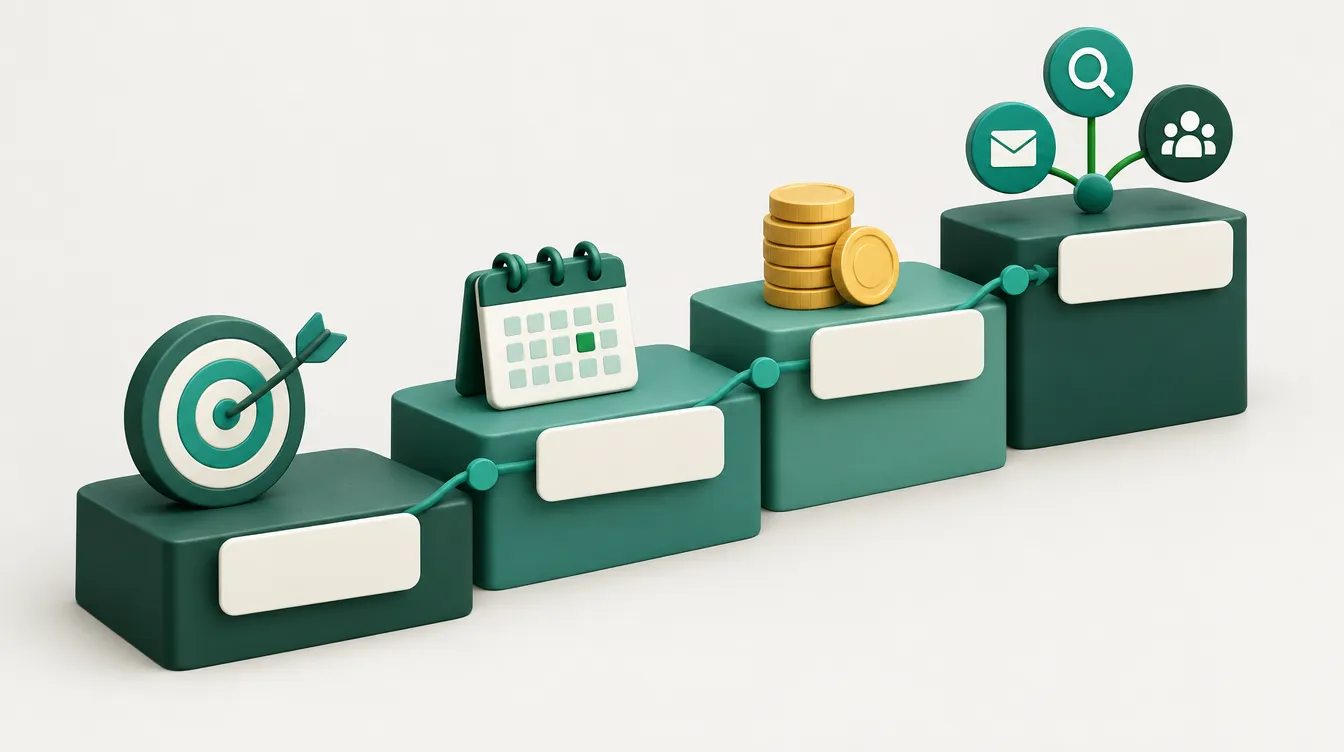
A funnel example for a small business
An illustrative example with hypothetical numbers, not one of our clients: a fictional accounting firm for the self-employed.
- 1Traffic: an article on deductible expenses draws search visitors; search ads test demand.
- 2Page: the article ends with a download offer.
- 3Lead magnet: a checklist of what to prepare for your accountant, in exchange for an email address and consent.
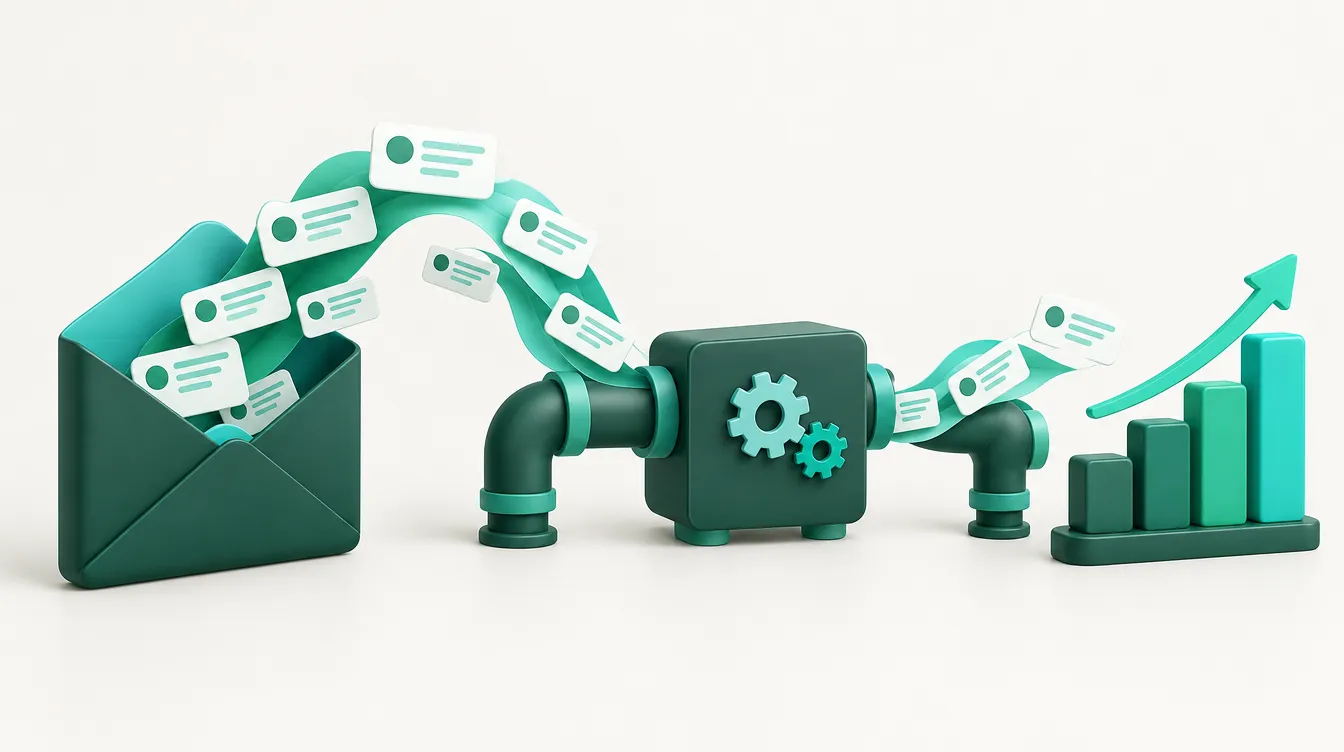
- 4Email sequence: three or four emails over two weeks: a tip, a common mistake, how you work. More in our email marketing guide.
- 5Offer: the last email invites readers to book an intro call.
| Step | People | Conversion rate |
|---|---|---|
| Article visits | 2,000 | – |
| Checklist downloads | 60 | 3% |
| Booked calls | 9 | 15% |
| New clients | 3 | 33% |
Where the funnel leaks and how to measure it
The key metric is the conversion rate between neighbouring stages: people in the next stage divided by people in the previous one, times 100. The overall rate (3 of 2,000 = 0.15%) won’t tell you where the problem is; the rates between steps will. In Google Analytics 4, a funnel exploration shows the drop-off between steps.
Quick fixes by leak
- Too few people at the top: content on what customers actually search for; search ads to test demand.
- Traffic without leads: one clear call to action per page, a shorter form, a lead magnet solving one problem.
- Leads don’t buy: an automated email sequence instead of a single “thank you”, a fast reply to enquiries, retargeting.
- Enquiries without orders: a clear price or scope, examples of your work, answers to typical doubts.
- One-off customers: a follow-up email after purchase, a review request, an offer of a related service.
Funnel vs. customer journey
The funnel is a simplified, linear model from the business’s point of view: how many people passed each stage. The customer journey describes the path from the customer’s side, with every touchpoint, doubt and return. Use the journey to plan content and channels, and the funnel to measure results and find the bottleneck.
When to bring in a specialist
You can sketch your funnel on paper in an hour. A specialist pays off when tracking is missing and you don’t know where people drop off, when ads don’t show a clear return, or when your email sequence and CRM should work automatically. We set up step tracking, design the pages and email sequence and bring in traffic through PPC campaigns, deciding by your funnel numbers. You can describe your situation via our contact form.
Frequently asked questions
What is a marketing funnel?
What do TOFU, MOFU and BOFU mean?
What is the AIDA model in marketing?
How do I find where my funnel loses customers?
What is the difference between a funnel and a customer journey?
Sources
Written by
Peter Gáborík
Founder of WebOptim and digital marketing specialist with a focus on web trends and SEO strategies.
Related service
Related articles