Dropshipping is a retail model in which an online store sells goods it does not keep in stock: it passes each order to a supplier, who ships the goods straight to the customer. You save on warehousing and upfront stock, but expect lower margins, less control over delivery, and full responsibility towards the customer, just like any other retailer.
At a glance:
- Dropshipping works best for testing a product range or as an add-on to a store with its own stock, less as a sole source of income.
- You are the seller: 14-day withdrawal, complaints and delivery times are your responsibility towards the customer, not the supplier's.
- Since 1 July 2026, shipments from outside the EU worth up to €150 pay a €3 customs duty per item; import VAT has applied since 2021.
- Margins tend to be thin because other stores sell the same goods from the same supplier. The advertising cost per order decides profitability.
How dropshipping works, step by step
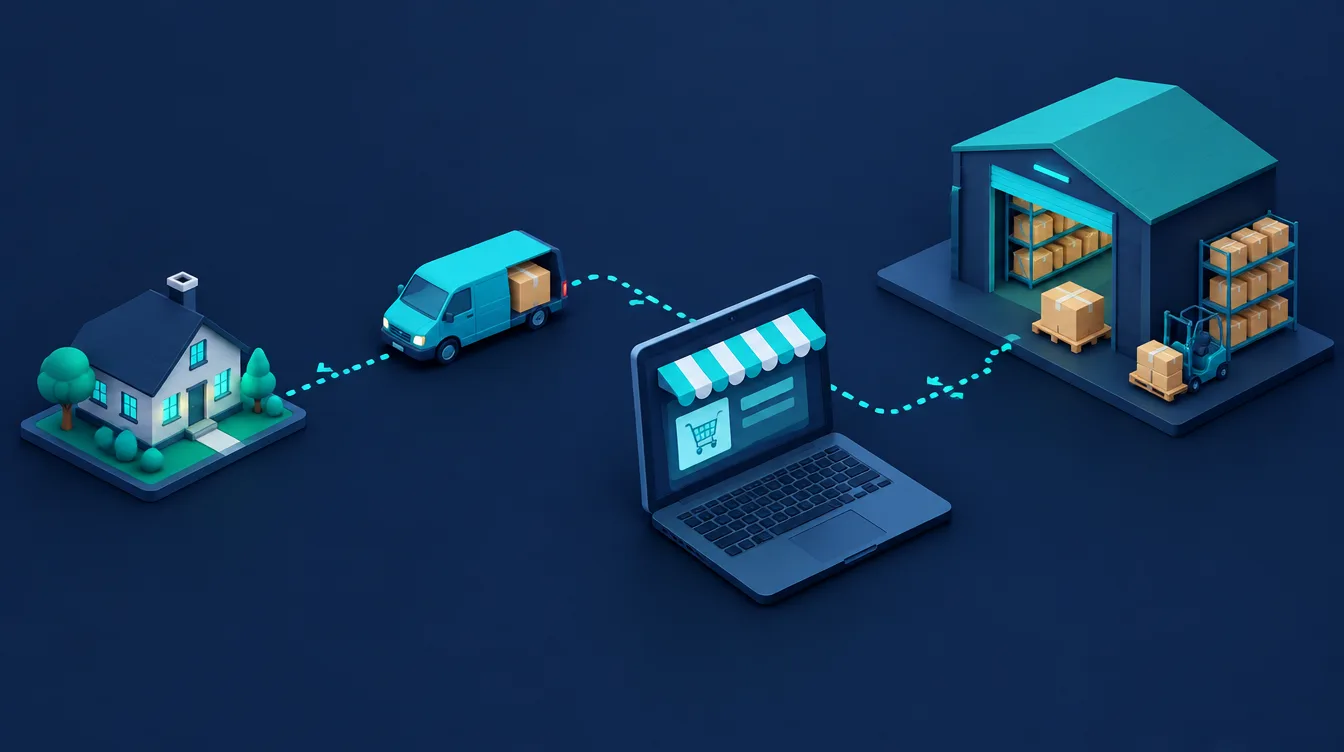
- 1The customer orders and pays on your store at your retail price.
- 2The store forwards the order to the supplier – manually, by email, or automatically via an integration.
- 3You pay the supplier the wholesale price, plus any handling and shipping fee.
- 4The supplier packs and ships the goods directly to the customer, ideally without its own invoice or flyers in the parcel.
- 5The difference between retail and wholesale price is your gross margin. It has to cover advertising, the payment gateway, the platform, returns and your time.
Suppliers usually provide products, prices and stock levels in an XML product feed that the store imports regularly. Most e-commerce platforms can import such feeds natively or through an add-on.
Pros and cons of dropshipping
| Pros | Cons | |
|---|---|---|
| Money | no upfront stock, low starting capital | lower margin than buying in bulk |
| Range | add hundreds of products quickly and test demand | competitors sell the same goods, often with the same copy |
| Operations | no warehouse, packing or shipping | supplier mistakes (out of stock, wrong parcel) land on you |
| Customer | wider range without the risk of unsold stock | less control over delivery time and packaging |
| Brand | fast start without manufacturing | hard to build your own brand and loyalty |
The biggest weakness of dropshipping is not technology but competition. When twenty stores sell the same product from the same supplier, price decides and margins shrink. The stores that succeed are niche, have better content and add extra service.
Dropshipping from China or from an EU supplier?
In Europe, dropshipping usually means either a supplier shipping from an EU warehouse or a supplier in China selling through large international marketplaces.
| EU supplier | Supplier in China | |
|---|---|---|
| Delivery | fast, like any online store | much longer, harder to promise a date |
| Purchase price | higher | low |
| Import duty and VAT | not applicable | VAT on every shipment, €3 duty per item since 1 July 2026 |
| Product safety (GPSR) | EU manufacturer or importer is traceable | you need a responsible person in the EU |
| Returns and complaints | goods are returned within the EU | returns to Asia are expensive, often at your cost |
Customs duty and VAT on shipments from outside the EU
On 1 July 2026 the EU abolished the customs duty exemption for consignments worth up to €150. Until 1 July 2028 a temporary duty of €3 per item applies (an item is counted by tariff classification, not by the number of pieces), and it is paid by the declarant, typically the seller or importer, not the consumer. Import VAT has applied regardless of value since 2021, and sellers can account for it through the IOSS scheme. The EU is also preparing a handling fee for processing parcels; its amount has not yet been set.
For dropshipping from China this means that cheap low-value items have lost much of their price advantage. Calculate your margin including duty before you list a product.
Obligations: what you are responsible for
The customer's contract is with you. The fact that a supplier physically shipped the goods does not change your obligations:
- 14-day withdrawal: consumers in the EU can return goods bought at a distance without giving a reason, and you refund them.
- Complaints: in the EU you are liable for defects for at least two years. Your local consumer law sets the deadline for handling complaints, and it runs for you even if the supplier is slow.
- Accurate information: delivery time, stock status and price including shipping must be true. Promising 2-day delivery on goods shipped from Asia is misleading.
- Product safety (GPSR): since 13 December 2024 every consumer product sold in the EU must have a responsible person established in the EU, and the online listing must show the manufacturer's details and that person's contact details.
- Business registration and VAT: you need to be registered as a business, and VAT obligations depend on your turnover and on where your customers are.
- Terms and GDPR: the same as for any online store, including telling customers that you share their data with the supplier for delivery.
For a full legal checklist, see our guide on how to start an online store.
How much can you make with dropshipping: an illustrative calculation
Illustrative example (a fictional home accessories store, not our client): a product sold for €39.90 including VAT from an EU supplier, shipping paid by the customer.
| Item | € per order |
|---|---|
| Retail price excl. VAT (assumed 23%) | 32.44 |
| Wholesale price | −18.00 |
| Supplier handling fee | −1.20 |
| Payment gateway (assumed 1.5%) | −0.60 |
| Advertising per order | −8.00 |
| Reserve for returns and complaints (3%) | −1.00 |
| Left for platform, operations and profit | 3.64 |
An order of almost €40 leaves less than €4. If advertising per order rises by €4, you break even. That is why dropshipping stores should track their conversion rate and cost per order from day one, and look for products with a higher basket value.
How to start dropshipping
- 1Pick a narrow niche where you can advise customers better than competitors. A generic store that sells everything loses on price.
- 2Vet the supplier: terms, fees, delivery times, how returns and complaints are handled and whether a stock-level feed is available.
- 3Place test orders to yourself and check speed, packaging and what arrives in the parcel.
- 4Choose a platform with feed import and automatic order forwarding. Our e-commerce platform comparison will help.
- 5Update stock levels several times a day so you do not sell items that are sold out.
- 6Write your own descriptions and photos where possible. The supplier's copy is used by dozens of other stores.
- 7Work out how much you can pay per order before launching ads, for example Google Shopping campaigns.
Who dropshipping suits
- Good fit: testing a new range without buying stock, extending a store with stock by complementary products, bulky or expensive goods that are not worth warehousing.
- Poor fit: if you want quick passive income, for cheap low-margin goods, for products where customers expect next-day delivery, and if you have no time to manage the supplier and customer support.
A common path is a mix: stock your best-sellers over time and keep dropshipping for the rest of the range.
Common mistakes
- Calculating margin without advertising, returns and duty.
- Updating stock once a day, so the store sells out-of-stock goods.
- Copying the supplier's delivery time without a buffer.
- Relying on a single supplier: if they change prices or stop, so does your store.
- Selling products from Asia without checking GPSR, labelling and instructions in the customer's language.
When to bring in an expert
You can set up a small dropshipping store on a hosted platform with one supplier yourself. An expert pays off when you need to connect several suppliers, forward orders automatically, combine dropshipping with your own stock, or when advertising is not profitable. Weboptim has delivered 50+ projects and can handle e-commerce development including feed integration, as well as PPC campaigns that keep the cost per order in check.
Frequently asked questions
Is dropshipping legal?
Who handles returns and complaints in dropshipping?
Is dropshipping from China still worth it?
How much does it cost to start dropshipping?
Can you make money with dropshipping?
Sources

Written by
Peter GáboríkProject Manager – AI, Automation & SEO
Project manager and founder of Weboptim. Builds growth strategies around SEO, automation and AI; in online marketing since 2017.
Related service
Tips that save time – once a month
One e-mail a month: a new guide, the automation of the month and one number from practice. No spam.