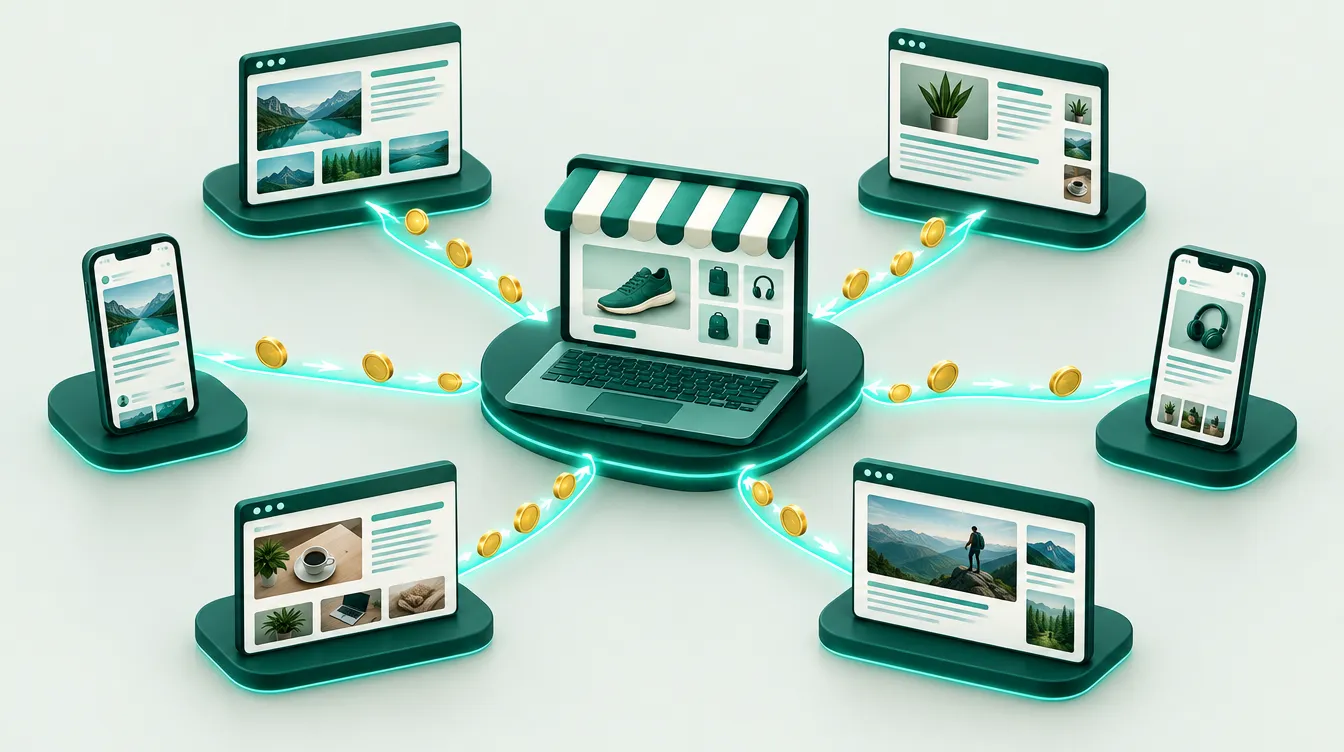
Affiliate marketing is a performance-based form of online marketing in which a partner (affiliate, publisher) promotes another company’s products and earns a commission only for results, typically a completed order or a new lead. For an online store, it is a sales channel where you pay not for impressions or clicks, but for sales partners actually bring in.
How it works in brief:
- 1The store launches a partner program and sets commissions and rules.
- 2The partner places a unique affiliate link on their website, in a newsletter or on social media.
- 3The system records which partner sent the visitor and tracks whether they buy.
- 4After approval, the partner gets a commission.
What is affiliate marketing and what to expect from it
Affiliate marketing (also partner or commission-based marketing) rests on a simple deal: you have the product, the partner has the audience. Unlike PPC advertising, you don’t buy clicks but an agreed result.
It is not an automatic source of cheap sales, though. Partners promote what earns them money: an attractive commission, a good conversion rate and reliable approvals. A neglected program mostly attracts coupon and cashback sites. Affiliate belongs in your marketing strategy as one channel, not a replacement for others.
How affiliate marketing works
Who is involved
- Advertiser (merchant): the store or company that runs the program and pays commissions.
- Affiliate partner (publisher): a content site, blog, comparison site, cashback portal or social media creator.
- Affiliate network: the platform in between, handling tracking, approvals, payouts and partner recruitment. An in-house program works without one.
Tracking: link, cookie and cookie duration
Each partner has their own link with an identifier. After the click, a cookie is stored, or the conversion is passed between servers (server-to-server tracking). If the customer buys within the set period, the order is credited to the partner. The advertiser sets the cookie duration in the program terms. A longer window attracts partners but risks paying for purchases that would have happened anyway.
Commission models
| Model | What you pay for | Typical use |
|---|---|---|
| CPS (cost per sale) | a percentage of a completed order | online stores |
| CPL (cost per lead) | a fixed amount per lead or enquiry | services, finance, B2B |
| CPA (cost per action) | a fixed amount per action, e.g. sign-up | apps, subscriptions |
Commissions are paid after approval. Returns and cancellations must be excluded, so tracking must be linked to real order status in your store.
A partner program for your online store: in-house or via a network
First decide whether to run the program yourself or through an affiliate marketing network.
| In-house program | Affiliate network | |
|---|---|---|
| Technology | affiliate software or plugin | the network handles tracking, payouts |
| Partners | you find them yourself | an existing partner base |
| Costs | licence and management time | fees per the network’s pricing |
| Best for | brands with a community, B2B | smaller stores starting out |
Affiliate marketing networks: examples
- CJ (Commission Junction): a global network owned by Publicis Groupe.
- Awin: a global network with teams in 17 markets and publishers in over 180 countries.
- Dognet and eHUB: regional networks for Central and Eastern Europe, useful if you sell in the Czech Republic or Slovakia.
Choose a network by where your customers are and which partners in your field use it.
How to launch an affiliate program
- 1Work out how much you can pay per order. Commissions must come out of your margin.
- 2Choose the commission model and cookie duration.
- 3Write the terms: allowed channels (PPC, email, cashback, coupon codes), order approval and payout schedule.
- 4Set up tracking and test it with a trial order, including a cancellation.
- 5Give partners a product feed, banners and current promotions.
- 6Contact niche blogs, comparison and review sites.
- 7Review each partner’s contribution monthly and adjust the terms.
The partner sends the visitor; your store has to close the sale. Site speed, a clear checkout and customer reviews affect results more than the commission rate.
Affiliate marketing programs: examples
- Amazon Associates: Amazon’s affiliate program, run separately for each marketplace (e.g. amazon.com, amazon.de). Partners must disclose that they earn from qualifying purchases.
- Booking.com: the Affiliate Partner Programme for travel and accommodation sites.
- AliExpress: the AliExpress Portals affiliate program.
- Alza: the Czech online retailer’s program for content and comparison sites.
Rates and terms change; check them in each program before signing up.
How to start as an affiliate
Affiliate is a content business. Commissions come from your audience’s trust, not from the number of links.
- 1Choose a niche you understand and where people compare before they buy.
- 2Create useful content: your own reviews, comparisons, buying guides. Google’s spam policies treat pages that copy merchant descriptions without added value as thin affiliation.
- 3Build on SEO or your own audience; see our article on SEO copywriting. Pinterest can complement this: it allows affiliate links that lead directly to the product if you disclose them.
- 4Pick programs by relevance and reliable approvals, not by the highest commission.
Be realistic: the first months are mostly content work. High ticket affiliate marketing (expensive products, high commissions) raises earnings per order but demands more trust.
Risks and rules
Cookie stuffing is fraud in which a partner drops an affiliate cookie without a real click and claims commission on a purchase they did not drive. Monitor click-to-order ratios and traffic sources.
Brand bidding means a partner bids on your brand name in search ads. You pay commission for a customer already looking for you, and your PPC campaigns get pricier. State your PPC rules explicitly in the program terms.
Disclosure: the European Commission explicitly lists affiliate marketing among advertising that must be disclosed under EU consumer law. Place the notice visibly next to the links.
The sponsored attribute: Google asks for links you are paid for to carry rel=sponsored (or nofollow). Affiliate links fall into this group.
When expert help pays off
You can launch a program yourself if you know your margins and have time for partners. Help pays off when your store doesn’t convert or commissions overlap with paid ads. We build online stores that turn partner traffic into orders and manage PPC so the channels don’t compete. Describe your situation via our contact form.
Frequently asked questions
What is affiliate marketing?
How does affiliate marketing work?
How much does an affiliate program cost an online store?
How do I start with affiliate marketing as a partner?
Do affiliate links need to be disclosed?
Sources
Written by
Peter Gáborík
Founder of WebOptim and digital marketing specialist with a focus on web trends and SEO strategies.
Related service
Related articles