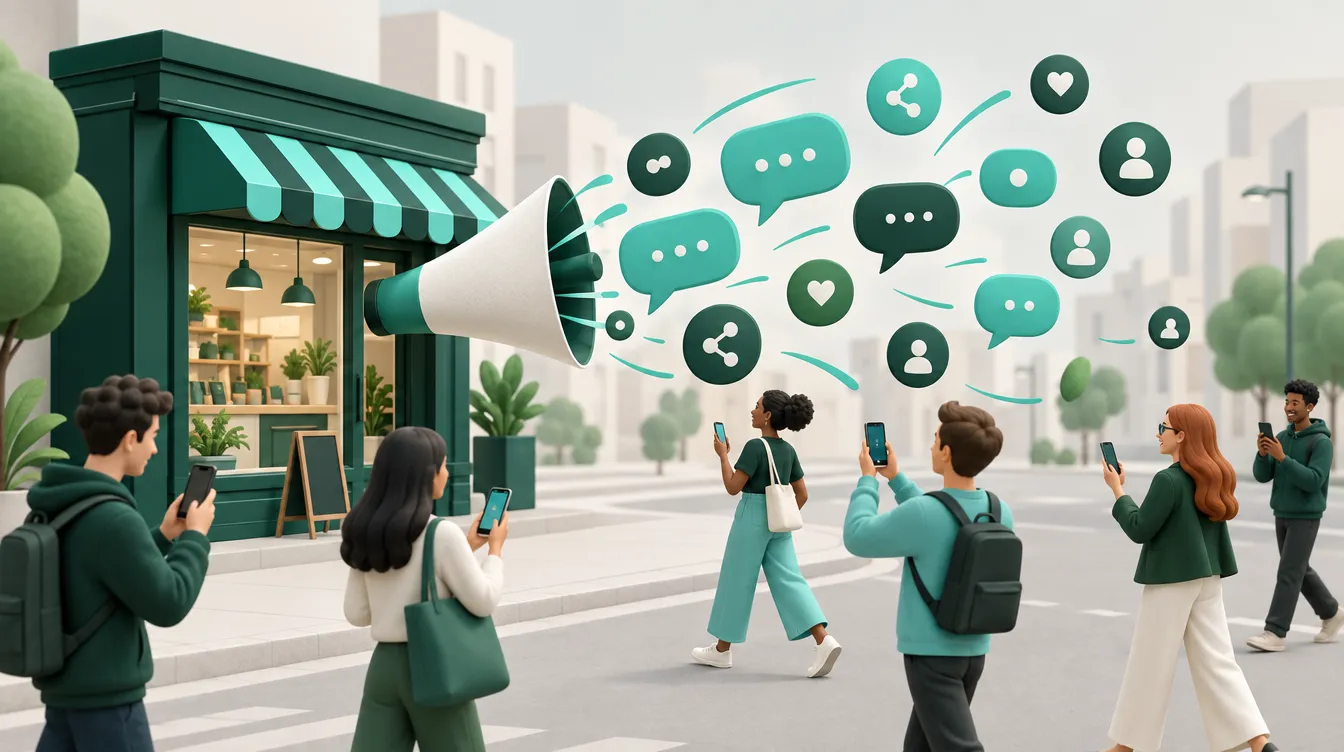
Guerrilla marketing, viral (buzz) marketing and influencer marketing are forms of promotion that rely on an idea, sharing and recommendations rather than a big media budget. They suit a small business with a clear goal, a way to measure results and its core channels covered. On their own, they won’t bring a steady flow of customers.
The overview in brief:
- Guerrilla marketing: an unconventional, low-cost action in a specific place, built on surprise.
- Viral and buzz marketing: content or a mechanism that people pass on by themselves.
- Influencer marketing: a paid or barter partnership with a trusted creator; paid posts must be disclosed.
- For a small business: start from the goal and measurement, not the form.
Guerrilla marketing: an idea instead of a budget
What guerrilla marketing is
Guerrilla marketing is unconventional promotion that works with surprise, place and timing instead of paid media space. The term was popularised by advertising executive Jay Conrad Levinson in his 1984 book of the same name, written for small businesses.
It rests on four principles: low cost, place (where your audience is), surprise and follow-up – without a QR or promo code, you won’t know what it brought.
Guerrilla marketing examples
Guerrilla marketing examples for a small business (illustrative):
- A café chalks arrows (with the owner’s consent) from the bus stop to its door, with a QR code for a discounted coffee.
- An online coffee shop adds a sample “for a colleague at work” to each parcel, with its own discount code.
- An accounting firm runs a permitted “tax return first aid” stand before the filing deadline.
Risks: permits and public space
Most cities require a permit or fee for promotions in public space, and sticking or painting on others’ property without consent is illegal. Actions can also backfire: in January 2007, Boston police mistook LED signs promoting the Aqua Teen Hunger Force film for explosives, and Turner Broadcasting and its agency paid USD 2 million.
Viral and buzz marketing: why content spreads
Viral marketing aims for content or a mechanism that people pass on themselves; Jeffrey Rayport popularised the term in a 1996 Fast Company article. Buzz marketing, a related approach, gets people talking about the brand online and in person.
Virality cannot be planned or bought, but you can raise the chance of sharing and make sure the attention turns into something.
Viral marketing strategies that work in practice
- 1Value for the sharer: the content helps, entertains or says something about them.
- 2One clear idea that is understandable within seconds, even without sound.
- 3Format by platform: see our social media marketing guide.
- 4A low barrier: a challenge, a template or a referral link.
- 5A ready website: a landing page, capacity and measurement before launch.
- 6A budget to kick-start it: sharing usually starts with paid promotion.
Viral marketing examples
Hotmail added “Get your free email at Hotmail” to every message and, per Britannica, gained 12 million users from mid-1996 to the end of 1997 on a USD 50,000 marketing budget. The 2014 ALS Ice Bucket Challenge involved over 17 million people and, per the ALS Association, raised USD 115 million. In both, sharing was built into the mechanism, not just an entertaining video. Smaller-scale buzz marketing: a limited edition or an unusual shop opening.
Influencer marketing: a paid recommendation
Influencer marketing is a paid or barter partnership with a content creator whose audience trusts them to recommend your product or service. You buy access to an audience, not guaranteed sales.
Types of influencers
The tiers are indicative (per Influencer Marketing Hub) and vary between sources.
| Type | Followers (indicative) | When it makes sense |
|---|---|---|
| Nano | under 10,000 | local services, niche |
| Micro | 10,000–100,000 | specialist products, online shops |
| Macro | 100,000–1 million | national awareness |
| Mega | over 1 million | large brands and budgets |
For a local business, nano and micro creators from the region usually beat a big name.
How to choose and measure
- Audience: ask for app statistics (country, age, interests).
- Engagement: genuine comments, not just emojis.
- Previous partnerships: did they recently promote a competitor?
- Written agreement: deliverables, deadlines, approval, content rights, disclosure.
- Measurement: a unique discount code, a UTM link and cost per order versus other channels.
Mandatory ad disclosure
In the EU, hidden advertising is an unfair commercial practice; the European Commission’s Influencer Legal Hub says brand partnerships and affiliate content must be disclosed. In a 2024 sweep of 576 influencers by the Commission and national authorities, 97% posted commercial content but only 20% systematically disclosed it. In the US, the FTC requires disclosure of any material connection with a brand, placed with the endorsement itself. Put disclosure into the contract; responsibility can extend to the brand.
Other forms of marketing at a glance
| Form | What it is | Who it suits |
|---|---|---|
| Event marketing | events, workshops, trade fairs | B2B, local services |
| Direct marketing | email, SMS, direct mail, telemarketing | businesses with a database |
| Video marketing | video on the web and social | products worth showing |
| Mobile marketing | SMS, push, apps | online shops, hospitality |
| Trade marketing | sales support via retailers | manufacturers, retail |
| HR marketing | the company as an employer | businesses that are hiring |
| RTB | real-time auctions for impressions | larger display budgets |
For a small business, direct marketing usually means email, which needs consent or an existing customer relationship (see our email marketing guide). Direct response marketing measures how many people reacted to an offer. For long-term trust, content marketing is often cheaper than one-off campaigns.
How to choose by budget and goal
None of these replaces the basics: a website, findability and regular communication. Start from your marketing strategy and fit the chosen form into the promotion part of your marketing mix.
| Goal | Small budget | Larger budget | How to measure |
|---|---|---|---|
| Local awareness | guerrilla action, event | local nano and micro creators | QR code, promo code |
| Online awareness | shareable content | video with paid promotion | reach, website visits |
| Sales and leads | direct marketing by email | micro creators with a code | cost per order |
| Hiring | HR marketing on social media | video from your workplace | number of applicants |
| B2B deals | event (workshop) | direct mail and phone | meetings, enquiries |
Before you launch, answer these questions:
- 1What single goal, and which number shows it?
- 2How much can you pay for an order or enquiry?
- 3How will you measure it: a code, UTM parameters, a QR code?
- 4Do you have permits, a disclosure plan and a ready website?
Low-ROI traps: a one-off action without measurement, a pricey macro influencer for a local service, and chasing a viral video with no offer on the website.
When to bring in a specialist
If you’re unsure which form to choose or want campaigns tied to your website and measurement, an outside view helps. At WebOptim, we build marketing from goals and numbers: we design the strategy, set up measurement and, as part of our social media management, prepare content and paid promotion. We have 8+ years and 50+ projects behind us. Describe your situation via our contact form.
Frequently asked questions
What is guerrilla marketing?
What is influencer marketing?
What is the difference between viral and buzz marketing?
Do influencers have to disclose ads?
Is guerrilla marketing worth it for a small business?
Sources
Written by
Peter Gáborík
Founder of WebOptim and digital marketing specialist with a focus on web trends and SEO strategies.
Related service
Related articles